Sacred Calendar
Important Dates for 2026
Pitru Paksha (also known as Mahalaya Paksha) is observed during the Krishna Paksha of the
Ashwini/Bhadrapada month. Mark the crucial dates for ancestral observances in 2026:
| Observance |
Date |
| Pitru Paksha 2026 Start Date |
September 26, 2026 |
| Pitru Paksha 2026 End Date |
October 10, 2026 |
| Mahalaya Amavasya 2026 |
Saturday,
October 10, 2026 |
Sacred Period
What Is Pitru Paksha?
Pitru Paksha is a sacred period traditionally dedicated to remembering departed parents and
ancestors. Families use these days to express gratitude, offer prayers and continue the
spiritual responsibilities followed within their family tradition.
In 2026, Pitru Paksha begins on September 26 and concludes with Mahalaya
Amavasya on October 10.
The method of observance can vary according to family, regional and spiritual traditions.
Some families offer simple prayers, while others arrange a personalized Amavasya Pooja or
Thila Homam.

Pitru Paksha: Sacred 15-day period dedicated to expressing gratitude and offering
prayers for departed ancestors.
Sarva Pitru Amavasya
What Is Mahalaya Amavasya?
Mahalaya Amavasya is the final day of Pitru Paksha. It is traditionally considered a
significant occasion for remembering all departed ancestors.
The day may be especially meaningful for people who:
- Recently lost their father or mother
- Miss their departed parents
- Could not complete certain
observances earlier
- Do not know an ancestor’s exact death
tithi
- Live outside India and cannot visit
their traditional place
- Want to continue their family’s
ancestral prayer tradition
- Want guidance about Amavasya Pooja or
Thila Homam
Read the complete guide to Mahalaya Amavasya Pooja 2026.
Respectful Guidance
Addressing Your Personal Circumstances & Concerns
I Recently Lost My Father or Mother. Can I Perform Amavasya Pooja?
Yes. Many families traditionally perform Amavasya Pooja to pray for the
peace of departed ancestors and remember them with gratitude.
If you have recently experienced the loss of your father, mother or another close family
member, our temple team can guide you respectfully regarding an appropriate observance
for your family tradition.
You do not have to make the decision alone. You can explain your situation privately to
our temple representative before booking.
I Could Not Perform the Rituals Earlier. Is It Too Late?
Many people feel worried or guilty because they could not perform a traditional
observance immediately after a parent’s passing.
Family circumstances, travel, health conditions and living outside India can sometimes
make rituals difficult to arrange. Traditional practices vary, but there may still be
meaningful ways to offer prayers and remember the departed person.
Mahalaya Amavasya is commonly regarded as an important occasion for ancestral
remembrance. Speak with our temple team to understand what may be suitable for your
circumstances.
I Don’t Know My Ancestor’s Exact Death Tithi
Some families may not know the exact date or lunar tithi on which an ancestor passed
away. Mahalaya Amavasya is traditionally observed as a common day on which families can
remember departed ancestors.
You can provide the information you know, such as the person’s name and relationship to
you. Our temple representative will explain what other details may be required.
Sincere Devotion
Amavasya Pooja for Departed Parents and Ancestors
Amavasya Pooja is a traditional prayer performed on the new moon day to remember ancestors
and pray for family well-being.
Devotees may perform this pooja with intentions such as:
- Remembering departed parents with
gratitude
- Praying for the peace of departed
family members
- Continuing an ancestral family
tradition
- Seeking harmony and unity within the
household
- Expressing love for parents who are
no longer physically present
- Finding a meaningful way to remember
family elders
Devotional Observance: The
pooja should be approached as a sincere devotional observance. It should not be presented as
a guaranteed solution to personal, medical, financial or family problems.
Read another detailed guide to Mahalaya Amavasya Pooja 2026.
Sacred Fire
Ritual
What Is Thila Homam?
Thila Homam is a traditional Vedic fire ritual involving offerings of sesame seeds into the
sacred fire with prescribed mantras.
It is traditionally associated with prayers for departed ancestors, remembrance and
spiritual peace. The ritual is performed under the guidance of trained priests according to
the required procedure.
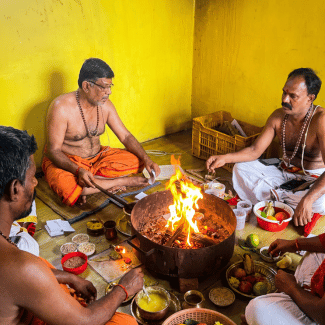
Thila Homam performed by trained Vedic scholars with individual family Sankalpam and
sacred sesame offerings.
People commonly enquire about Thila Homam when they:
- Want to pray for departed parents or
ancestors
- Could not perform certain observances
earlier
- Want to perform an ancestral prayer
during Pitru Paksha
- Have been advised to learn about
ancestral rituals
- Are unsure whether Amavasya Pooja or
Thila Homam is suitable
- Live outside India and need an online
participation option
Read more about the meaning and significance of Thila
Homam.
Step-by-Step Rites
What Happens During Thila Homam?
The exact procedure may differ according to the tradition followed by the priest. It
generally includes:
- Collection of the devotee’s Sankalpam details
- Preliminary prayers
- Invocation of divine blessings
- Offerings of sesame seeds into the sacred fire
- Recitation of prescribed Vedic mantras
- Prayers for departed ancestors
- Concluding prayers and blessings

Authentic Shastric sequence of Thila Homam conducted by experienced Acharyas.
Read the detailed procedure of Thila Homam.
Content Analysis &
Comparison
Amavasya Pooja or Thila Homam: Which One Should I Choose?
Understand the precise Shastric differences, ritual depth, and spiritual scope of
Amavasya Pooja versus Thila Homam as analyzed by Astro
Aadhesh temple acharyas:
| Aspect / Feature |
Amavasya Pooja |
Thila Homam (Pitru Dosha Pariharam) |
| Spiritual Purpose |
Regular Devotion
Monthly prayer & gratitude offering for peace of departed parents and
general household harmony.
|
Deep Karmic Release
Vedic fire oblations to liberate 3 generations of pitru souls and dissolve
severe ancestral Pitru Dosha.
|
| Ritual Offerings & Core |
Lamp & Flowers
Devotional archana, offering of flowers, fruits, and light to departed
ancestors.
|
Sesame & Fire Oblations
Sacred Agni Kunda rites with up to 8,000 black sesame seed (Thila) & cow
ghee Ahutis into consecrated fire.
|
| Vedic Priests & Duration |
1 Vedic Priest
Conducted by 1 priest in approximately 30 to 45 minutes.
|
Up to 8 Vedic Acharyas
Comprehensive 8-stage Shastric homam conducted by 4 to 8 learned Vedic scholars
lasting approx. 4.5 to 5 hours.
|
| Sankalpam Customization |
General Family Sankalpa
Prayer recited with family karta's name & ancestor names.
|
Full Individual Lineage Sankalpa
Exclusive booking invoking family Gotram, Janma Nakshatra, Rashi & 3
generations of deceased pitru names.
|
| Observance Frequency |
Monthly Amavasya
Recommended for regular monthly new moon days.
|
Pitru Paksha / Specific Tithis
Performed during Pitru Paksha, Mahalaya Amavasya, or specific astrologically
guided remedies.
|
| Live Streaming & Video |
Pooja Video
Personal pooja video sent to WhatsApp after completion.
|
2-Way HD Live Stream + Video
Scheduled interactive live video stream + complete HD video proof of full Gotram
recitation.
|
| Prasadam Delivery |
Standard Prasadam
Blessed kumkum/chandan sent via courier.
|
Energized Homam Bhasma & Raksha
Energized Agni Bhasma (sacred ash), consecrated Raksha Sutra & dry prasadam
dispatched worldwide.
|
| Ideal Circumstance |
Remembrance & Love
For families seeking monthly peace of mind, remembering parents, and maintaining
ancestral tradition.
|
Ancestral Curses & Obstacles
For families suffering persistent marriage delays, lineage issues, unexplained
debts, or unnatural demises.
|
The appropriate observance depends on your family tradition, circumstances and the guidance
you are seeking.
If you are unsure, speak with our temple representative before booking.
Auspicious Timing
Can Thila Homam Be Performed During Pitru Paksha?
Yes. Many families consider Pitru Paksha a meaningful period for prayers
connected with departed ancestors.
In 2026, Pitru Paksha runs from September 26 to October 10. Thila Homam may
be performed during this period when appropriate to the devotee’s family tradition.
The concluding day, Mahalaya Amavasya on October 10, 2026, is considered
especially significant for ancestral remembrance.
Sacred Location
Selection
Where Should Thila Homam Be Performed?
Thila Homam should be conducted respectfully by trained priests who understand the required
Vedic procedure.
Before selecting a place, devotees should consider:
- Whether the ritual is personalized
- Whether trained priests perform it
- Whether an individual Sankalpam is
included
- Whether online participation is
available
- Whether a personal pooja video is
provided
- Whether the team explains the ritual
clearly before booking

Personalized Vedic homams arranged at Aadhesh Lakshmi Narayana Temple with direct priest
coordination.
Read further in-depth resources:
Global NRI & Online
Services
Online Mahalaya Amavasya Pooja and Thila Homam
Devotees living in India or abroad can arrange Mahalaya Amavasya Pooja or Thila Homam
online.
This can be helpful for devotees who:
- Cannot travel to the temple
- Live outside India (USA, UK, Canada,
Australia, Singapore, Middle East, Europe)
- Have elderly family members
- Cannot take leave from work
- Want the ritual performed with their
family details
- Want to participate from home
The pooja or homam is performed at the temple with the submitted Sankalpam details. Live
participation or personal video arrangements can be explained during booking.
Sankalpam Requirements
Information Required for Booking
You may be asked to provide:
- Devotee’s name
- Nakshatra, if known
- Gothram, if known
- Names of the departed ancestors
- Relationship to the departed person
- Selected pooja or homam
- Country and time zone
- WhatsApp number for confirmation and
updates
If you do not know your Nakshatra, Gothram or the exact death tithi, speak with our
temple team before booking.
Ritual Process
What Happens After Booking?
After you complete the booking:
- You receive payment confirmation.
- Your Sankalpam information is collected.
- The pooja or homam is scheduled.
- Trained priests perform the selected ritual.
- Live participation details or a personal video are shared according to the selected
service.
Devotee FAQs
Frequently Asked Questions
Find answers to common questions about Mahalaya Amavasya 2026 dates, Amavasya Pooja, and
Thila Homam:
Answer: Pitru Paksha 2026 starts on September 26, 2026.
Answer: Pitru Paksha ends on October 10, 2026, with the observance
of Mahalaya Amavasya.
Answer: Mahalaya Amavasya falls on Saturday, October 10, 2026.
Answer: Yes. Many families perform Amavasya Pooja to remember
departed parents and pray for their peace. Our temple team can guide you according
to your circumstances and family tradition.
Answer: Many devotees perform Amavasya Pooja as an expression of
love, remembrance and gratitude towards departed parents and ancestors.
Answer: Amavasya Pooja is a traditional prayer and offering
performed on Amavasya. Thila Homam is a Vedic fire ritual involving sesame offerings
and prescribed mantras.
Answer: The suitable ritual depends on your family tradition,
circumstances and the guidance you require. Speak with our temple representative
rather than selecting a ritual based only on general
information.
WhatsApp: 9840924789
Answer: Yes. Families who do not know an ancestor’s exact death
tithi often consider Mahalaya Amavasya a meaningful day for collective ancestral
remembrance.
Answer: Traditional practices vary, but there may still be
meaningful ways to offer prayers later. Our temple team can understand your
situation and explain the available observances respectfully.
Answer: Different traditions interpret Pitru Dosha differently. Do
not assume that a particular ritual is required without suitable guidance. Speak
with a knowledgeable representative who can explain the traditional options.
Answer: Some families perform Thila Homam during Pitru Paksha or on
Mahalaya Amavasya according to their family tradition and priestly guidance.
Answer: Yes. NRIs and devotees living outside India can book online.
Participation and personal video arrangements can be confirmed during booking.
Answer: Yes. Women can book and participate according to their
family traditions and personal circumstances.
Answer: You are not alone in feeling this way. Many people use
prayer as a sincere expression of love, gratitude and remembrance. Our team can
guide you without judgement or pressure.
Answer: You may provide your name, Nakshatra, Gothram and the names
of the ancestors for whom the prayers are offered. If some information is unknown,
speak with the temple team.
Temple Helpdesk
Speak With Our Temple Representative
If you recently lost a loved one, do not know which ritual to choose or need guidance
regarding your family tradition, our team can assist you respectfully.
Bookings Open
Book for Mahalaya Amavasya 2026
Pitru Paksha: September 26
to October 10, 2026
Mahalaya Amavasya: Saturday, October
10, 2026
Pillar & Research Links
Related Pages & Guides
Explore authoritative ancestral guides, ritual procedures, and sacred insights:

 Vedic Ancestral Rituals • Individual Family Sankalpam • Worldwide Live Stream